



Implementing a portfolio decarbonisation pathway
The emissions covered by decarbonisation pledges rose by 70% of global emissions between 2017 and 2022, according to data from the International Energy Agency. Now investors must play their part, not only by reducing their own portfolio carbon footprints but also by holding governments, issuers and asset managers accountable to those pledges.

Each investor’s journey will be different, with some at more advanced stages than others. Many are constrained by regulations, while others may choose to prioritise alternative corporate objectives. Fiduciary duties may also influence the speed at which asset owners decarbonise their investment portfolios, along with the level of beneficiary and client scrutiny, the organisational asset-liability profile and available resources to implement changes, which will ultimately meet the goals of the Paris Agreement.
Decarbonisation techniques
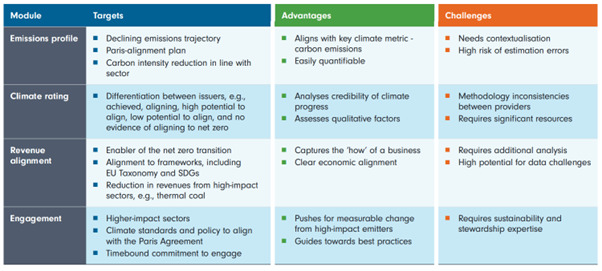
There are two main avenues towards net zero for investors – decarbonising the aggregate investment portfolio and investing in climate solutions. In the first instance, a modular approach to decarbonise portfolios offers investors four levers to influence climate outcomes (Figure 1). These tools can be applied on their own but are generally used together to optimise results.
Figure 1. Four levers for decarbonising portfolios
Source: Fidelity International, 2023.

Investing in climate solutions includes products and services for ensuring a smoother energy transition. Issuers in this category focus on two goals – wider adoption of existing ways to mitigate and adapt to climate change, and innovations required to meet net zero targets. These strategies generally focus on five broad industry groups: transportation, power, industry, buildings and consumer.
How investors choose to gauge their climate-aware investing strategy depends on their initial baselines and portfolio ambitions. Unsurprisingly, a proliferation of portfolio emissions regulations, policies, guidelines and other tools have emerged globally over the past decade to help strengthen the reliability, transparency and accountability of key performance indicators. However, they can be difficult to decipher.
Greening portfolios
Data and framework availability, regulatory support and organisational constraints dictate that investors often do not have the resources to implement a decarbonisation strategy for the aggregate portfolio all at once. Therefore, they need to prioritise investment mandates deemed to be the most achievable to decarbonise.
Of all asset classes, listed equities – particularly in developed economies – are perhaps the starting point to decarbonise for most organisations due to the relative availability, comparability and reliability of data, more established investment best practices and regulatory and corporate support frameworks.
However, listed equities account for less than a quarter of total emissions, according to estimates by the Climate Accountability Institute. The global fixed income market also offers investors attractive decarbonisation opportunities. It is larger in terms of total outstanding debt in 2021 at $123.5tn compared to the global equity market capitalisation of $105.8tn with annual issuance that also dwarfs that of equities.
Furthermore, managing a climate-aware portfolio cannot be limited to public markets. Standards must be just as rigorous when investing in private markets. Otherwise, issuers and asset owners can sidestep public scrutiny by shifting into the private sphere, undermining long-term sustainability goals along the way.
Comparing passive, systematic and active fundamental strategies
Choosing the right implementation approach to advance climate ambitions is the next key component of the decarbonisation pathway. Every decision is an active one, whether investors use indexing, systematic (rules-based) or active fundamental strategies. Even when tracking an index, investors must decide whether to use a Paris-aligned benchmark, a climate transition benchmark or a bespoke benchmark. These decisions involve trade-offs between non-financial goals, such as the pace of portfolio decarbonisation, and financial goals, including risk appetite, tracking error and volatility limits.
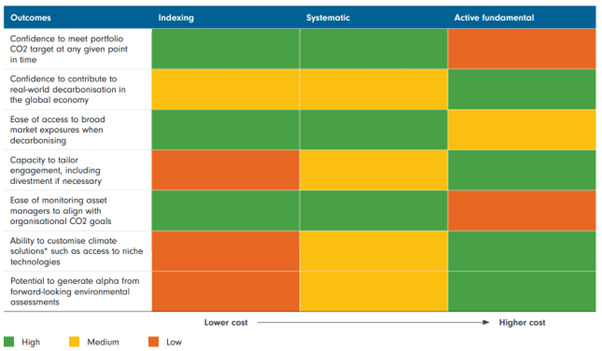
Figure 2. Common allocation strategies versus portfolio decarbonisation outcomes
Source: Fidelity International, 2023.
How investors transition their climate-aware investing portfolio depends on the nature of the decarbonisation pathway, along with other factors such as the organisational governance structure, implementation budgets and investment horizon. Figure 2 compares three common implementation strategies against specific outcomes.
One of the difficulties when indexing, for example, is how to divest an issuer if engagement fails within a certain time period. In general, neither the asset manager nor the asset owner has direct control over the construction of most indices. One solution is to underweight, and some asset managers are exploring ways to use shorting to influence corporate behaviours.
On the other hand, active fundamental strategies require closer monitoring of asset managers to ensure alignment to investors’ climate goals, relative to indexing and systematic approaches. However, regulatory changes combined with technological advances potentially are making that task easier and more granular.
Generational investing
Undoubtedly this is one of the most difficult tasks facing investors, though it is also one of the most crucial to leave beneficiaries, clients, employees and future generations with financial security that is grounded in a sustainable economy. Traditionally, sustainability has been viewed as separate from an organisation’s financial security, with many investors reluctant to introduce and implement portfolio decarbonisation targets because of concerns that they may negatively affect returns. We disagree.
We believe financial security relies on the wellbeing of the ecosystem. Therefore, tackling climate change should not be considered an ‘add-on’ but a necessary component of financial security. And just like the net zero transition itself, the longer the wait the higher the cost and the more volatility to be expected. As well as being the right thing to do for the planet, climate-aware investing is a critical alignment of long-term fiduciary interests.